
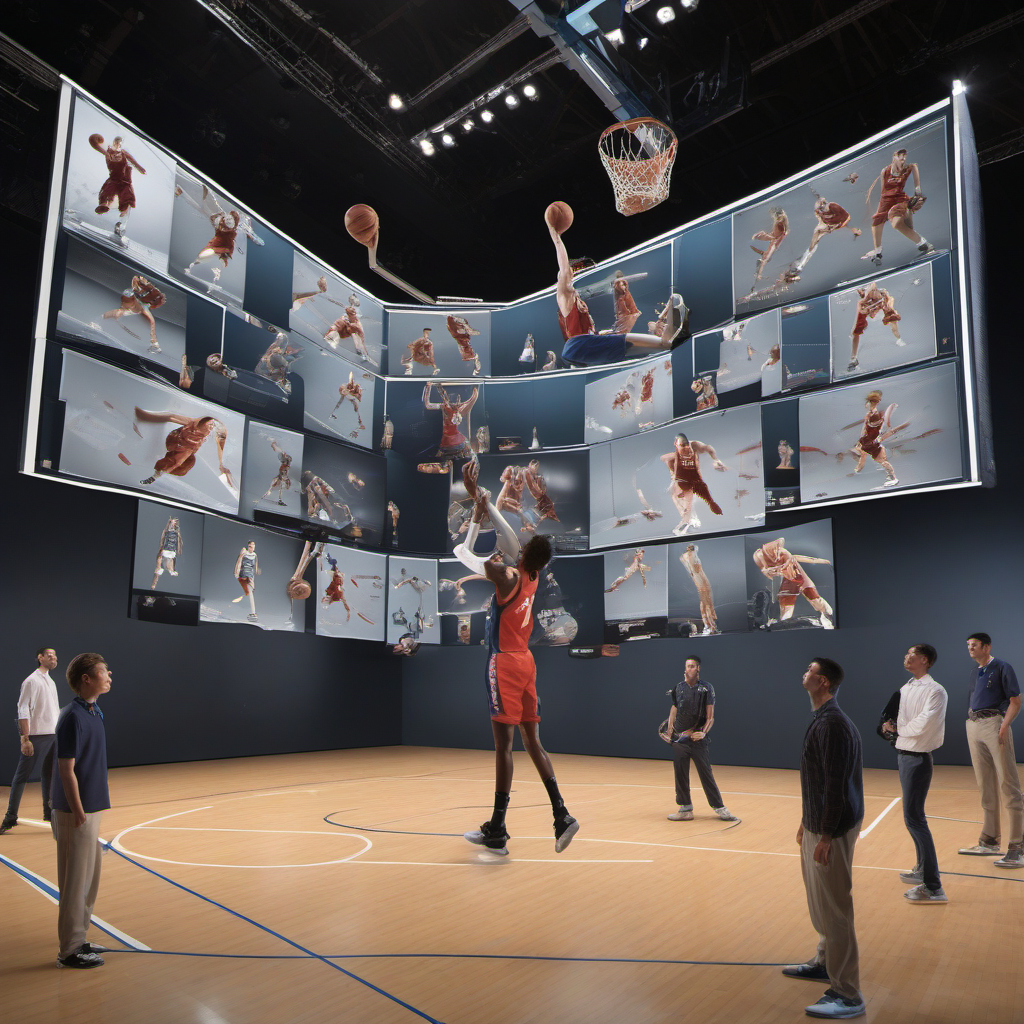
Peripheral Labs has set its sights on transforming basketball coaching with the establishment of a biomechanics basketball shooting lab in Toronto. Partnering with Quantum Sports and Learning Association (QSLA), this venture aims to bring advanced spatial intelligence technology to the forefront of sports training. As the first of its kind outside the NBA in North America, this lab is not just a playground for athletes but a testing ground for Peripheral’s ambitious AI technology. With its headquarters newly relocated to Toronto, Peripheral is betting on the Canadian tech scene to refine and showcase its offerings.
### What Peripheral Labs Does
Peripheral Labs is leveraging its cutting-edge AI technology to analyze and enhance basketball shooting techniques. The company has developed a large reconstruction model (LRM) that transforms two-dimensional camera footage into three-dimensional video, providing detailed biomechanical insights. Set up in a former factory now turned sports and educational hub in Toronto’s Dovercourt Village, the lab features 36 cameras strategically placed around the court. This setup allows Peripheral to continuously gather data, a significant upgrade from its previous, more sporadic data collection efforts. The goal is to use this data to improve player performance by pinpointing subtle mechanical adjustments that can make or break a shot.
### Competitive Context in Sports Tech

The sports technology landscape is crowded with companies promising data-driven performance enhancements. However, most existing solutions focus on metrics like speed and agility rather than the biomechanics of individual movements. Peripheral Labs is carving out a niche by concentrating on biomechanics, specifically shooting mechanics in basketball. While other companies, such as HomeCourt and ShotTracker, offer analytics for basketball, they largely focus on shooting percentages and court mapping, not the granular level of biomechanical analysis that Peripheral is targeting. By focusing on biomechanics, Peripheral hopes to address a gap in the market, potentially offering coaches and athletes a more scientific approach to skill development.
### Implications for Founders, Engineers, and the Industry
For startup founders and engineers, Peripheral’s move is a case study in leveraging niche expertise to stand out in a competitive field. The company’s shift from San Francisco to Toronto highlights a strategic decision to capitalize on Canada’s burgeoning tech scene and its less saturated market. It also underscores the importance of partnerships—in this case, with QSLA—to gain credibility and access to a steady stream of data for refining technology. For the sports industry, particularly basketball coaching, the integration of biomechanical analysis could redefine training methodologies, offering a more personalized and data-driven approach to skill enhancement.
### What Happens Next
As Peripheral continues to refine its technology in Toronto, the company is poised to expand its offerings beyond basketball. The lab serves as a proving ground for its AI capabilities, with potential applications in other sports and even broader fields like physical therapy and rehabilitation. For engineers and developers, the evolving needs of such technology offer opportunities for innovation in AI and machine learning. For investors, the success of Peripheral’s lab could signal a lucrative opportunity in the intersection of sports and technology. As Peripheral’s technology matures, it will be crucial for stakeholders to consider scalability and adaptability to other domains, potentially redefining how we understand and improve athletic performance.