
Google has unveiled Gemini Embedding 2, a groundbreaking AI model designed to integrate text, images, video, audio, and documents into a unified numerical space. This innovation is set to significantly reduce latency and costs for enterprises leveraging AI for data management. By enabling native multimodal capabilities, the model aims to streamline enterprise data processes and enhance the efficiency of AI-driven tasks.
## Gemini Embedding 2: A New Era for Data Representation
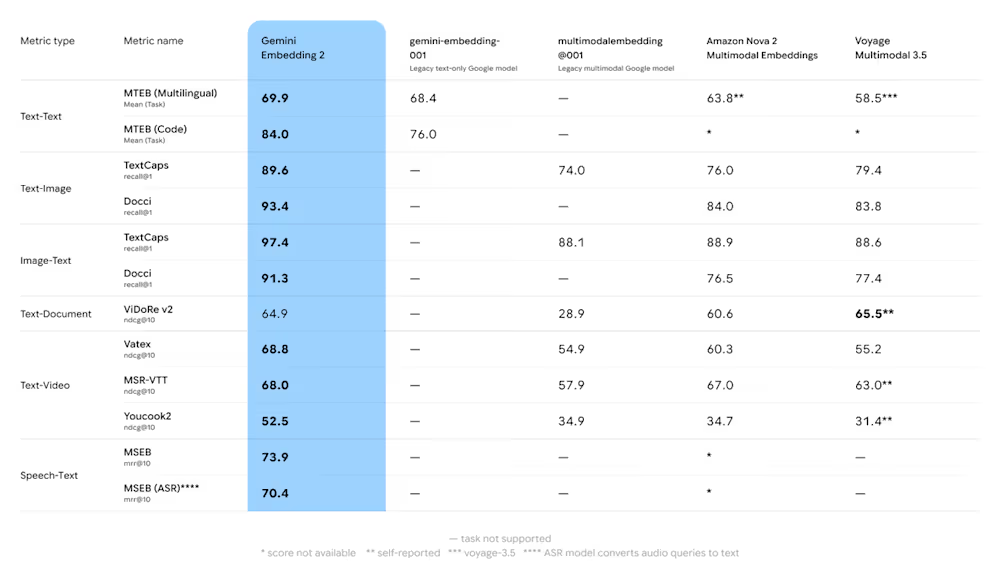
Google’s Gemini Embedding 2 represents a major shift from traditional text-first models to a natively multimodal approach. This model directly processes various media types without converting them to text, thereby reducing errors and capturing more nuanced data. By embedding all media into a single 3,072-dimensional space, it allows for seamless cross-modal retrieval, such as using text queries to locate specific moments in videos or images.



The model introduces Matryoshka Representation Learning, which enables the nesting of key information within the first few numbers of a vector. This feature allows enterprises to choose between full precision or reduced dimensions to save on storage costs while maintaining accuracy. Early adopters like Sparkonomy and Everlaw have reported significant efficiency gains, with latency reductions of up to 70% and improved semantic similarity scores.
## Competitive Landscape and Industry Context
Gemini Embedding 2 positions Google at the forefront of the AI embeddings market, challenging established players like OpenAI and Anthropic. While OpenAI’s text-embedding-3 series remains popular, Google’s move to a fully multimodal model could set a new industry standard. The ability to process and retrieve data across multiple formats without intermediate steps gives Google a competitive edge in enterprise AI applications.
The introduction of this model highlights the growing demand for integrated AI solutions that can handle diverse data types. As businesses increasingly rely on AI for data-driven decision-making, the need for efficient, scalable models like Gemini Embedding 2 becomes crucial. This development reflects a broader industry trend towards simplifying AI pipelines and enhancing the accuracy of information retrieval.
## Implications for Enterprises
For enterprises, the adoption of Gemini Embedding 2 offers the potential to transform data management and retrieval processes. By unifying disparate data formats into a single embedding space, companies can create more cohesive knowledge bases, improving the accuracy and speed of AI-driven insights. This is particularly valuable in sectors like legal tech, where rapid access to multimedia evidence can be pivotal.
The model’s public preview availability allows enterprises to begin testing and integrating it into their operations. Google’s tiered pricing model and integration with platforms like LangChain and Weaviate further facilitate this transition, making it accessible for both startups and large-scale enterprises. As businesses look to streamline their AI workflows, Gemini Embedding 2 offers a compelling solution that aligns with the evolving needs of modern data environments.
As Google continues to refine Gemini Embedding 2 during its public preview phase, enterprises have the opportunity to explore its capabilities and assess its impact on their data strategies. The model’s ability to seamlessly integrate various data types could redefine how organizations approach information retrieval, setting new benchmarks for efficiency and accuracy in the AI landscape.