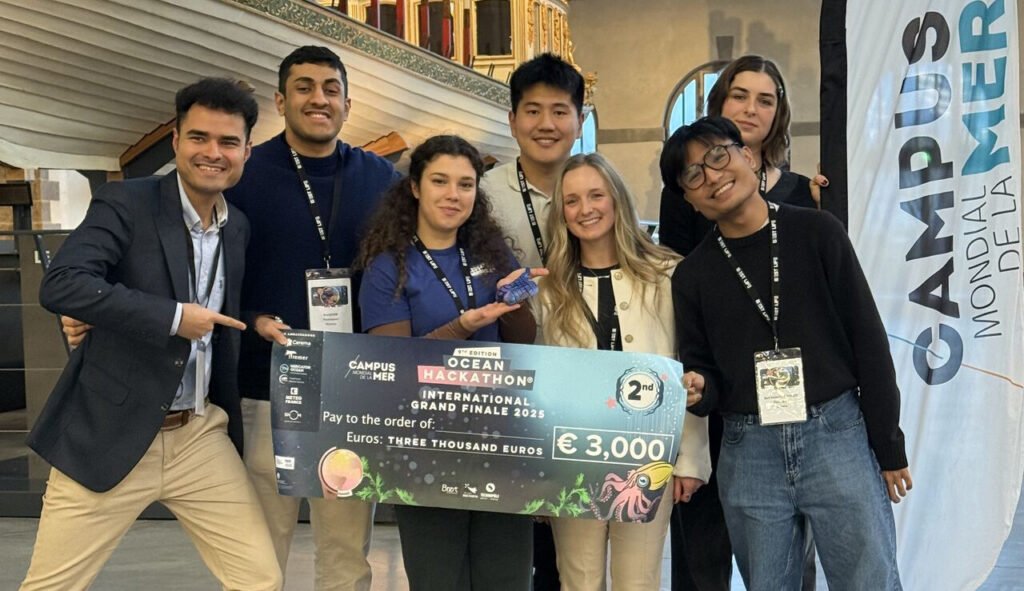
British Columbia’s ocean innovation ecosystem earned international recognition this week as a B.C. based team placed second at the Ocean Hackathon 9 Grand Finale in Brest, France on December 2.
The result reinforces Pacific Canada’s growing reputation as a hub for marine technology, data driven innovation, and sustainable ocean solutions.
A Global Competition Focused on Ocean Data
The Ocean Hackathon is an annual 48 hour international competition designed to unlock new uses for digital technologies in ocean science, sustainability, and management. Organized by Campus Mondial de la Mer, the event connects innovators across coastal cities who work with open marine data to tackle real world challenges.
Each participating city hosts a local competition, with the winning team advancing to the Grand Finale. This year, 57 teams competed globally, with 10 finalists representing Canada, France, Malaysia, Portugal, Brazil, South Africa, Congo, Spain, and Croatia.
British Columbia’s First Ocean Hackathon
British Columbia hosted its first ever Ocean Hackathon this fall in Victoria. The event was organized jointly by Centre for Ocean Applied Sustainable Technology and Ocean Networks Canada at the COAST Hub.
The initiative was supported through funding from Canada’s Ocean Supercluster and Syniad Innovations.
Organizers cited British Columbia’s unique position as both a technology hub and home to Canada’s fastest growing ocean innovation community as a key reason for launching the event in the province.
The Winning Team and Their Project
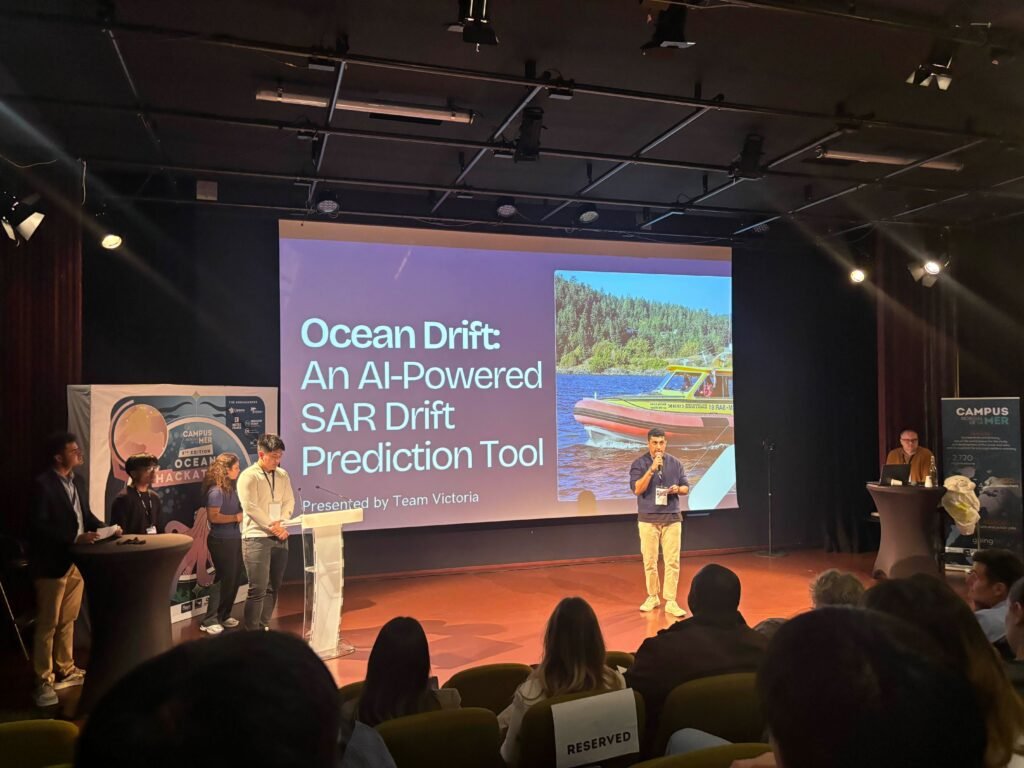
The British Columbia team consisted of Yi Leon Zhen, Noel John, Udbhav Kansal, Dom Torres, and Polina Erofeeva. They were the only team from British Columbia, Canada, and North America to advance to the global Grand Finale.
Their project, Ocean Drift, uses artificial intelligence and deep learning to analyse complex surface ocean currents in the Strait of Georgia. The team demonstrated how the tool could be used to improve search and rescue operations by better predicting the movement of objects and people at sea.
The project stood out for its practical application of real world ocean data and its potential impact on safety and operational efficiency.
Recognition on the Global Stage
At the Grand Finale in Brest, the B.C. team placed second overall and received a prize of 3,000 euros. The first place team came from Kuala Lumpur, Malaysia, with a real time AI system designed to help fish tank operators optimise feeding and reduce pollution. Third place was awarded to a team from Brest, France, for developing an AI powered tool to map coastal pathways.
British Columbia was also represented on the international judging panel by Camille Ruest, Operations Coordinator at COAST, who led production of the Victoria competition.
Strengthening the Pacific Blue Economy
COAST’s role as a connector between ocean industry, researchers, investors, and innovators was highlighted throughout the event. Organisers say the success of the Victoria competition and the team’s performance in France demonstrates the value of creating platforms that allow emerging talent to work with Canada’s extensive ocean data resources.
COAST Executive Director Jason Goldsworthy said competitions like the Ocean Hackathon provide early stage teams with a way to experiment, validate ideas, and begin the journey from concept to commercialisation.
For TechScoop Canada, the result reflects a broader trend. As climate, sustainability, and ocean management challenges grow more complex, innovation increasingly depends on data, interdisciplinary collaboration, and regional ecosystems capable of competing on a global stage.
British Columbia’s podium finish in France signals that Pacific Canada is becoming one of those ecosystems.